Let's start with a childhood story.
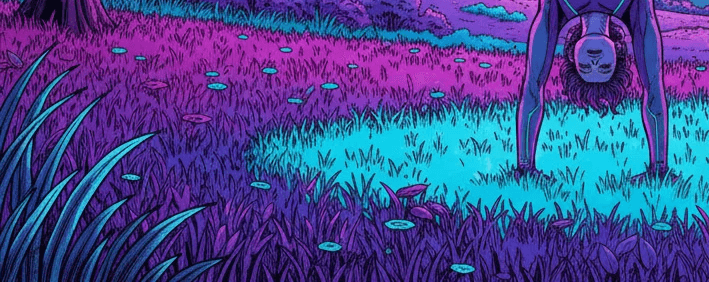
The gym floor was worn and scuffed—crossed by colored lines, marked by years of running feet. I placed my hands flat on the surface, leaned forward, and tried with everything I had to kick my legs up toward the mat propped against the wall.
It didn't work.
The PE teacher had asked Veronika—who did gymnastics outside of school—to show the rest of us how a handstand against the wall was done. It looked effortless on her. When the teacher tried to help by lifting my legs, I panicked, my arms buckled, and I went down. Scraped my chin on the way in that specific, infuriating way that only a gym floor can manage.
I have no idea how it went for my classmates. I was too busy being ashamed of my own clumsiness. I quietly slipped away from the group and moved to another corner.
That was the first and last time I tried to do a handstand. For over twenty years.
I was nine years old. I had tried exactly once. And I had already decided: I am someone who cannot do handstands.
Growing up, I quietly built a list of things I couldn't do. I was probably seven or eight when I decided I wasn't good at dancing. Around thirteen when I concluded I couldn't sing. Fortunately there were things I was good at, so it was easy enough to lean into those and avoid the rest—sidestep the shame, dodge the vulnerability, stay where things felt comfortable.
It was so much easier to keep going where things already worked. And for several years I lived my life that way.
Now. Take a moment.
How old were you when you first knew what you were bad at?
Maybe it's math. Drawing. A sport. No ball sense. No rhythm. Not musical. What did someone tell you—a teacher, a parent, a classmate—that quietly lodged itself into how you see yourself?
The Scars We Carry
For most of us, it gets decided early: what we're good at and what we're not. What we're good at gets nurtured—by ourselves and by others. What we're not good at, we learn to avoid. Gradually, our abilities become woven into our identity. Without quite realizing how it happened, we become someone who can in some areas, and someone who can't in others.
The problem is that getting good at something almost always requires being bad at it first. But the older we get, the harder that feels.
There's real vulnerability in being a beginner. Especially in creative or physical expression—where effort is visible, the body is exposed, and failure happens in front of other people.
Brené Brown, who has spent decades researching shame, found something that stopped me in my tracks. In Daring Greatly, she writes:
"85 percent of the men and women we interviewed for the shame research could recall a school incident from their childhood that was so shaming that it changed how they thought of themselves as learners. What makes this even more haunting is that approximately half of those recollections were what I refer to as creativity scars. The research participants could point to a specific incident where they were told or shown that they weren't good writers, artists, musicians, dancers, or something creative."
Half. Half of us are carrying a creativity scar—a specific moment when someone told us, directly or indirectly, that this arena wasn't for us.
And here's the thing about a scar: it forms because something mattered. We don't scar over things we don't care about. The reason a PE teacher's passing comment or a choir director's rejection can echo for decades is because you longed for it - often even loved it. And when we love something and get hurt through it, the natural response is to protect ourselves by never going back.
Brown noticed something else, too. Unused creativity doesn't just sit quietly. It metastasizes—into resentment, grief, a low hum of longing that's hard to name. Elizabeth Gilbert put it plainly in conversation with Brown: people with creativity scars were told they could no longer be makers. Only consumers. Watchers. Audience members in their own lives.
People can go an entire lifetime without singing again—even though it's what they most deeply long for. Here's where I am tearing up.
The Longing Behind the Resistance
When I went to performances with acrobatics, dance, and live music, I was moved. Inspired. But stronger than any of that was something that felt closer to grief.
If only I could. If only I could move like that. Express myself like that. Be that strong.
It wasn't about wanting to go professional. Not about being that good. It was simpler and more personal than that—just the desire to do it. To experience it from the inside. To become, even in a small and imperfect way, someone who does.
A friend of mine described her relationship with skiing in a line I've never forgotten:
"Outwardly I refused. Inwardly I longed."
As a child she had been the worst skier in her family. Gradually she became the one who stayed behind in the cabin while everyone else hit the slopes. The mountain holidays her family loved became something to endure. That identity—I'm not a skier—hardened over the years into something that felt like fact.
As an adult, she tried again. With a completely different relationship to herself. She describes it as twenty-five years of carrying the memory of something that felt like trauma—that took four days to move through once she finally dared to try again.
Four days. Twenty-five years of avoidance. Four days to come out the other side.
What Is Beginnership, Really?
The concept of beginnership came to me several years ago, as I tried to put words to something I kept experiencing—again and again—as surprisingly, almost unreasonably rewarding.
I went through a phase of trying things I previously thought I had absolutely no business trying. Pole dancing. Stand-up comedy. Graffiti. Singing. Surfing. My actual skill level in any of these was, to put it generously, pretty shaky. But something kept happening—not in the skill, but in me.
I was developing a different relationship with not knowing how. An ability to stand confidently in being genuinely, spectacularly bad at something—and still enjoy it. Still commit. A playfulness where every small step forward felt like a genuine surprise. I realized it had nothing to do with getting good. It was about what happens when you do something at all that you never thought you could.
Beginnership is the practice of dismantling the illusion of what we think we can and cannot do. That fixed, inflexible self-image that makes us smaller than we are—and smaller than we want to be.
And the more entrenched that illusion, the longer you've avoided something, the deeper the scar—the more radical it is to step toward it anyway.
Back on the Gym Floor
I'm thirty years old. My gaze is on a gym floor again—but everything else is different.
The room is full of welcoming acrobats at every level. Next to me stands my friend Niclas—one of the best hobby acrobats in the city, and one of the friends who, earlier that summer, quietly coaxed me into trying partner acrobatics in a sun-warmed park. Just to see.
To my genuine surprise, it turned out I wasn't someone who can't do acrobatics. It turned out I just needed to be allowed to be exactly as much of a beginner as I was—and in good company, fail enough times to stop being afraid of it.
Years later, I still can't do a freestanding handstand (I've managed 3 seconds at best). Not without a wall or a friend nearby. But I know now that it's not because I'm someone who can't. I'm someone who hasn't learned it yet. Someone who hasn't failed at it enough times.
We all are.
We just haven't practiced what we never allowed ourselves to try.
Beginnership Is a Skill
Here's what I've come to believe: beginnership isn't just a mindset. It's a skill. And like any skill, it grows with practice.
The more we exercise the vulnerability and courage it takes to show up and genuinely try something we're probably terrible at, the more manageable it becomes. I think we build something deep in our sense of self—a tolerance where our identity is no longer so tightly tied to what we can and can't do. Where we can be terrible, impressive, and somewhere in between across a whole range of things. Where what we practice, we improve. And where we gradually become the ones shaping our own abilities rather than being shaped by the limits we once accepted.
I don't have research to back this specific claim—but I believe something shifts in us when we act against a fixed story about ourselves. That practicing beginnership in one area quietly unlocks it in others. We learn that those walls are just illusions. We learn it wasn't as dangerous as we thought to be bad at something. We stop letting our results define us.
And eventually, we get genuinely good at being pretty bad at things. We become secure in our beginnership.
There's also something worth saying about leading others through it. Encouraging curiosity, making learning feel safe and even joyful—most parents will recognize this impulse. But turning that same generosity toward yourself is harder. We often coach others beautifully while being merciless with ourselves.
The practice is learning to cheer for yourself—with a little structure and a lot of courage.
One more thing: it's almost always harder to be the one asking for help than the one giving it. For the person reaching out, it feels enormous. For the person helping, it's usually just... enjoyable. Most people love sharing something they care about with someone who genuinely wants to learn. So if the vulnerability of asking feels too big—know that on the other side of that ask, someone is probably glad you did.
Reclaim the Arena
Behind resistance, there is almost always longing.
That particular mix of pain and desire—watching someone dance and feeling an ache because you're not part of it, because you decided long ago you didn't belong there—that ache is worth listening to.
Beginnership is the act of walking back onto the arena you quietly gave up. Of saying: I get to be here too. Of reclaiming a space that was always yours to begin with.
It doesn't require being good. It requires being willing.
Step by step, the arena becomes yours. A place you belong. And suddenly you're not just someone who wishes—you're someone who does. Someone who dances. Who paints. Who leads. Who speaks in front of people. Who tries.
The first step will be shaky. That's exactly how it should be. You'd never seriously tried before.
By now, I've become genuinely, cheerfully mediocre at a long list of things that wouldn't impress many people. I am a very experienced beginner—with what I've come to think of as a hard-won and quietly rare skill: being comfortable with being bad at things.
And I'm very proud of that.
What arena have you been watching from the outside—and what would it take to step back in?
Read more
